Battleship turns a hidden grid into a game of deduction. You arrange your ships, take turns choosing coordinates, and use the results to work out where your opponent's fleet is hiding. If you want to play Battleship online for the first time, you can learn the core idea quickly and begin making better guesses within a few turns.
Set up the fleet
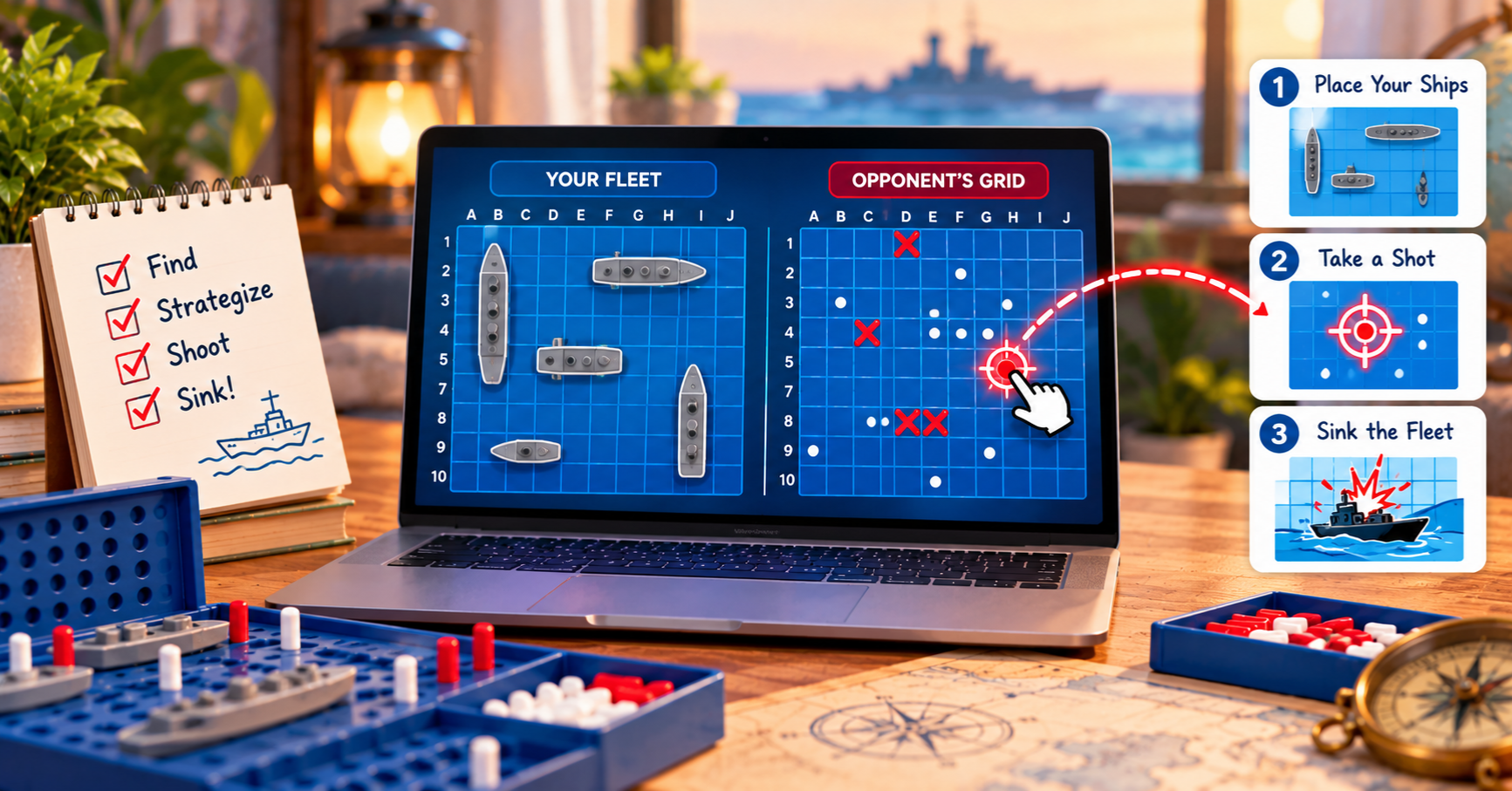
In the familiar two-player Battleship game, each player has a grid where they place ships and a separate view for tracking shots at the opponent. Ships occupy several neighboring squares in a straight horizontal or vertical line. They cannot bend. Fleet sizes, board dimensions, and whether ships may touch one another can differ between versions, so check the on-screen rules before placing your ships.
Your opponent cannot see your ship positions during play, and you cannot see theirs. Once the setup is complete, the search begins. You are trying to find and sink all opposing ships before your opponent sinks yours.
Call a coordinate and record the result
On a standard labeled grid, a shot is a coordinate such as B4: a letter identifies one axis and a number identifies the other. Your opponent or the game reports whether the shot is a hit or a miss. A hit means part of a ship occupies that square. A miss means no ship is there. When all squares occupied by one ship have been hit, that ship is sunk.
Some versions change whose turn comes next after a hit or include additional game options. The essential habit is the same: track every result and avoid firing at a square you have already tested. An online Battleship board usually marks earlier shots, but it still helps to look at the pattern instead of selecting coordinates at random.
Turn a hit into useful information
Your first hit gives you a starting point. Because ships run in a straight line, the most informative next shots are usually the untested squares directly above, below, left, and right of the hit. If one of those also hits, you may have found the ship's direction. Continue along that row or column, checking the other end if needed, until you identify the whole ship.
Do not assume every game uses a rule that prevents ships from touching. Unless the version says so, a nearby hit might belong to a different ship. Let the recorded outcomes and the game's stated rules guide your next shot.
Balance searching and finishing
Before you find a ship, spread your shots across untested areas. After a hit, focus on the surrounding squares that could continue a straight vessel. Switching between these two modes gives your choices a purpose: first locate a target, then determine its position and length.
Placement matters too. If you put every ship against the edge or arrange them in an obvious pattern, a repeat opponent may begin to predict you. Choose legal positions, vary them from game to game, and check that your fleet is fully placed before you start.
Open Battleship on Entertainment Couch and give your first naval battle a simple goal: record every hit and miss, then explain to yourself why you chose each next coordinate. Winning is satisfying, but learning to read the grid is what makes the next round more interesting.